
Welcome to Future technology
1.What is Artificial Intelligence?
Artificial intelligence (AI) refers to the simulation of human intelligence in machines that are programmed to think like humans and mimic their actions. The term may also be applied to any machine that exhibits traits associated with a human mind such as learning and problem-solving.
2.General perception of people about Robots ?
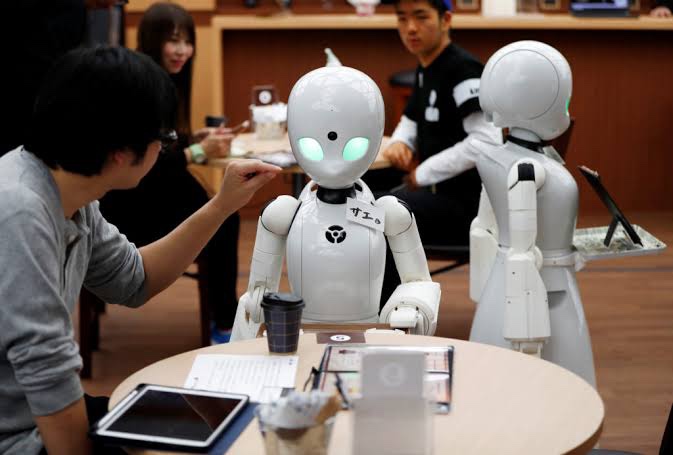
As robots increasingly take part in daily living activities, humans will have to interact with them in domestic and other human-oriented environments. This thesis envisages a future where autonomous robots could be used as home companions to assist and collaborate with their human partners in unstructured environments without the support of any roboticist or expert. To realise such a vision, it is important to identify which factors (e.g. trust, participants’ personalities and background etc.) that influence people to accept robots’ as companions and trust the robots to look after their well-being. I am particularly interested in the possibility of robots using social behaviours and natural communications as a repair mechanism to positively influence humans’ sense of trust and companionship towards robots

The main reason being that trust can change over time due to different factors (e.g. perceived erroneous robot behaviours). In this thesis, I provide guidelines for a robot to regain human trust by adopting certain human-like behaviours. I can expect that domestic robots will exhibit occasional mechanical, programming or functional errors, as occurs with any other electrical consumer devices
This led us to investigate whether people’s awareness of robots’ functionalities may affect their trust in a robot. I found that people’s acceptance and trust in the robot may be affected by their knowledge of the robot’s capabilities and its limitations differently according the participants’ age and the robot’s embodiment.
3.What is the scope of Artificial Intelligence?
Scope of Artificial Intelligence-
The scope of Artificial Intelligence in India is promising. Artificial Intelligence has immense potential to change each sector of the economy for the benefit of society. There is not just one technology under AI, but there are various useful technologies such as self-improving algorithms, machine learning, big data, pattern recognition. Soon, there would hardly be any industry or sector which would be untouched by this powerful tool in India. This is the reason why there has been an increasing demand for online Artificial Intelligence online courses in India.
Important of AI in different field are;
1.Education – Artificial Intelligence can help increase the effectiveness of our instructors via numerous AI applications such as text translation systems, real-time message to speech, automating mundane and also repeated jobs such as taking presence, automating grading, customising the discovering trip based upon ability, understanding, and also experience. The scope of Artificial Intelligence education and learning takes a look at the possibility of utilising AI ran rating machines that can evaluate unbiased solutions. This is something that is gradually being implemented in institutes. The various other applications of AI in the area of education are real-time text to speech as well as text translation systems.
Healthcare – The Healthcare system in India is the most dynamic and challenging sector in India. There are many challenges like affordability, accessibility but particularly the shortage of doctors and services like qualified nurses, technicians, and infrastructure. In India, good healthcare facilities are mostly near the tier1 and tier2 cities which creates non-uniform accessibility to healthcare across the country with physical access. Apart from this, with the development of Artificial Intelligence, the overall cost of healthcare would get reduced due to increased efficiency. With the ability of AI to handle large data in a speedy fashion it can help in making innovations, design, and developing medical equipment. Having an AI-enabled system helps in reducing medical errors and increases productivity. Artificial Intelligence can also overcome the barriers to access and solve the accessibility challenge by employing early detection followed by suitable diagnostic decisions.
3.Artificial Intelligence in Cyber Security – Cybersecurity is another field where Artificial Intelligence is employed. Many organisations deal with a significant amount of data. For example, in the Banking sector or government organisations which are having a huge database of people’s personal data, there is always a risk of stealing, and hence a security mechanism needs to be put in place. An apt example of this field is Cognitive Artificial Intelligence. It detects as well as analyses hazards, while also giving understandings to the analysts for making better-informed decisions. By making use of Machine Learning formulas and also Deep Learning networks, the AI obtains better and much more resilience over time. IBM has IBM Resilient, which is an open as well as an agnostic platform that offers a framework and also center for managing safety and security responses.
Chatbots : In a country as varied as India, the combination of chatbots in the digital framework or availability via the IVRS system education domain can be transformational– they might be educated on the subject matter and a great percentage of doubts of the pupils could be responded to quickly, consequently lowering the current work of educators who could focus on even more imaginative tasks.

4.What is the difference between AI and Emotional Intelligence?
Artificial Intelligence as “the simulation of human intelligence as processed by machines,” is the aim of hundreds and thousands specialists all over the world.
In 2018 AI already can a lot of things and enterprises invest millions in it:
Natural language generation
Speech, text, image recognition
Smart home and virtual agents
Machine Learning and Deep Learning platform
AI optimized hardware
Decision management
Biometrics
Robotics
AI modeling
Cyber defense
Aid for knowledge worker
Content creation
Peer to peer networks
Healthcare
Automation in marketing
And so on.
The key difference between where we are with AI today versus human and animal brain is multitasking.
With multiple AI functions built into the same package or single computing block, AI systems will achieve better, faster performance due to the synergies between systems. This will enable AI to accomplish abstract reasoning, allowing machines to execute sophisticated, non-intuitive actions that bring them a step closer to us. (Neurala)
Next years AI powered systems would perform whole medical diagnostics and surgery, could simulate work of the entire brain in all kinds of business, industries and safety programs.
But still, is there something AI can’t do?
As researchers predict, “human” professions will be related with Emotional Intelligence in future.
Today, everyone stay agree that AI was created not to replace people, but to help, to improve, to do better and faster. It causes lots of discussions and issues but we won’t talk about it.
According to Andrew Coleman’s A Dictionary of Psychology (2008), emotional intelligence is defined as, “the capability of individuals to recognize their own emotions and those of others, discern between different feelings and label them appropriately, use emotional information to guide thinking and behavior, and manage and/or adjust emotions to adapt to environments or achieve one’s goal(s).” It is measured most often using the EQ-i 2.0 test, which measures trait emotional intelligence.
Such job as customer service is human based because humans could recognize emotions and feelings better that AI.
Empathy, gratitude, happiness, anger, understanding someone’s mood are reserved for EI and humans today.
Don’t forget about differences in humans psyches: we all percept things and react as an individuals, there are great number of psychological diseases and variations of emotion manifestation.
Nevertheless, AI tends to learn emotion recognition.
Emotion recognition is the process of identifying human emotion, most typically from facial expressions as well as from verbal expressions. This is both something that humans do automatically but computational methodologies have also been developed.
As we see AI use facial and verbal tips for recognize the emotion. Moreover, AI based on machine learning will collect data and analyze it for better work.
As diverse sources say the following datasets are available for emotion recognition:
HUMAINE: provides natural clips with emotion words and context labels in multiple modalities
Belfast database: provides clips with a wide range of emotions from TV programs and interview recordings
SEMAINE: provides audiovisual recordings between a person and a virtual agent and contains emotion annotations such as angry, happy, fear, disgust, sadness, contempt, and amusement
IEMOCAP: provides recordings of dyadic sessions between actors and contains emotion annotations such as happiness, anger, sadness, frustration, and neutral state
eNTERFACE: provides audiovisual recordings of subjects from seven nationalities and contains emotion annotations such as happiness, anger, sadness, surprise, disgust, and fear
BLOG DONE ✅
Nikshith K S
Arun kumar
Dayanand
PRUTHVEESH
Kishan Gowda
Sneha kulkarni
Deepashree
 Artificial Intelligence
Yaa it’s nice & knowledgeable…
LikeLiked by 1 person
Good Information
LikeLiked by 1 person
Informative blog
LikeLiked by 1 person
Good Effort 👍 on AI
LikeLiked by 1 person
Good info
LikeLiked by 1 person
Good ..👏
LikeLiked by 1 person
Nice try👏
LikeLiked by 1 person
Brilliant effort
LikeLiked by 1 person
Amazing write up 👍🏻👍🏻
LikeLiked by 1 person
Good information, it will be helpful
LikeLike
Great work!! 👍
LikeLike
Very good try!… Keep going..info is lite..come up with more useful info + creativity!
LikeLike
Good job guys!
LikeLike
Nice
LikeLiked by 1 person
Well presented!👏🏻
LikeLiked by 1 person
😊 Thank you
LikeLike
Good job guys
Information is lite and good
Image are really gd
Editing has done in a decent manner
👏🏻👏🏻👏🏻
LikeLiked by 1 person
great work
LikeLiked by 1 person
Very nice
LikeLike
Nice
LikeLike
Tq
LikeLike
Good job!
Very nice….
LikeLike
nice work👍
LikeLike
Informative article for beginners! Keep it up
LikeLiked by 1 person